The first time I heard the term “AI FinOps” was a few months ago, on an Arcana Research call with a Fortune 500 company. We interview company leaders to understand their AI spending and governance, then turn those conversations into board-level reports and industry benchmarks.
The company is considered a leader in AI transformation, so I wasn’t surprised by the number of models, compute structures, AI software products, and other initiatives it had running. What surprised me was how well-structured the entire operation was. So I asked, “How do you manage all of this spend?”
“Oh, we have a few AI FinOps people for that,” he replied nonchalantly.
They made it sound like the role was already the norm. It wasn’t, especially at companies that weren’t as AI-pilled. But with AI costs blowing up this year, that’s changing. More enterprises are looking for someone to help wrangle costs in some version of this role.
The job postings are starting to reflect it. CVS Health, Citibank, ServiceNow, Stripe, Micron, and others are all hiring for some version of the role. Even OpenAI has a director of product finance focused on managing its internal AI economics.
For enterprises, 2026 can be summarized as the year they went from tokenmaxxing to cost optimization. Many started the year aggressively adopting Claude Code and giving anyone inside the company who wanted it an unrestrained budget. The problems showed up quickly.
Uber became the clearest example. By April, Claude Code had reached 84% of its roughly 5,000 engineers, and the company had already exhausted its full-year AI budget. CTO Praveen Neppalli Naga said he was “back to the drawing board.” He had also spent $1,200 worth of tokens during a single two-hour internal demo.
And Uber was one of the more optimistic cases. An AI consultant told Axios that an unnamed client spent $500 million on Claude in a single month. Microsoft started canceling most of its direct Claude Code licenses after opening access to thousands of employees because the bill was getting too expensive. Amazon basically wasted nearly $2 million using Claude Sonnet to sync author details on its site. The project ran 860% over budget, went unnoticed for five months, and ultimately failed.
According to Mavvrik's 2026 State of AI Cost Governance Report, 40% of organizations surveyed said these AI cost surprises escalated to board-level discussion.
Tokenmaxxing makes sense for small teams and individual developers or vibe coders. For enterprises, it makes very little sense. The past 15 years were dominated by predictable software costs as technology spending moved toward subscription-based, per-seat pricing. That model made it easy for procurement and finance teams to predict IT spending as a function of headcount. Add more engineers, add more software seats. Simple and straightforward, now time for happy hour.
AI has completely flipped that model on its head. Enterprises now have to rethink how they predict and analyze costs. AI vendors are moving toward usage-based or outcome-based pricing, both dramatically different from the simplicity of subscriptions. You’re taking a fixed-cost structure and turning it into a variable one with very little predictability. Token consumption varies across functions, roles, and individual employees, often depending on how comfortable each person is with the tools.
Early data from Arcana Research shows the gap clearly. 86% of procurement respondents said model or API token usage was among the hardest AI spend to see or control. 71% had finance budget approval in place, but only 14% had a seat or usage-cap approval. Enterprises have built the gates to buy AI. They haven't built the controls to manage what happens next.
The problem is ownership. The person approving the money rarely sees what makes it expensive. Finance signs off on AI spending, but 78% of FinOps teams now report to a CTO or CIO. Engineering makes the routing, caching, and model decisions that determine the bill.
That split has consequences. Finance sees the total after the money is spent; engineering sees the token usage as it happens. Neither owns the whole picture. In a 2026 survey of 700 FinOps and engineering leaders, 52% said their organization had no single owner of AI costs. If spending doubled overnight, only 20% could explain why within hours. AI FinOps is the person sitting in both rooms.
The underlying question around all this is: how do I get the strongest ROI per token? It's important to remember that not all tokens are created equal; it depends entirely on what they're used for. Asking ChatGPT what the weather is today is, from an enterprise perspective, a waste of tokens. Asking 5.6 Sol to write a memo that saves five human hours can create far more value for the company, both obvious and less visible. Measuring that difference is the hard part.
One helpful framework is the Token Leverage Matrix. Plot any AI interaction on two axes, cost and leverage, and it falls into one of four buckets: Noise, Waste, Free Lunch, or Worth It.
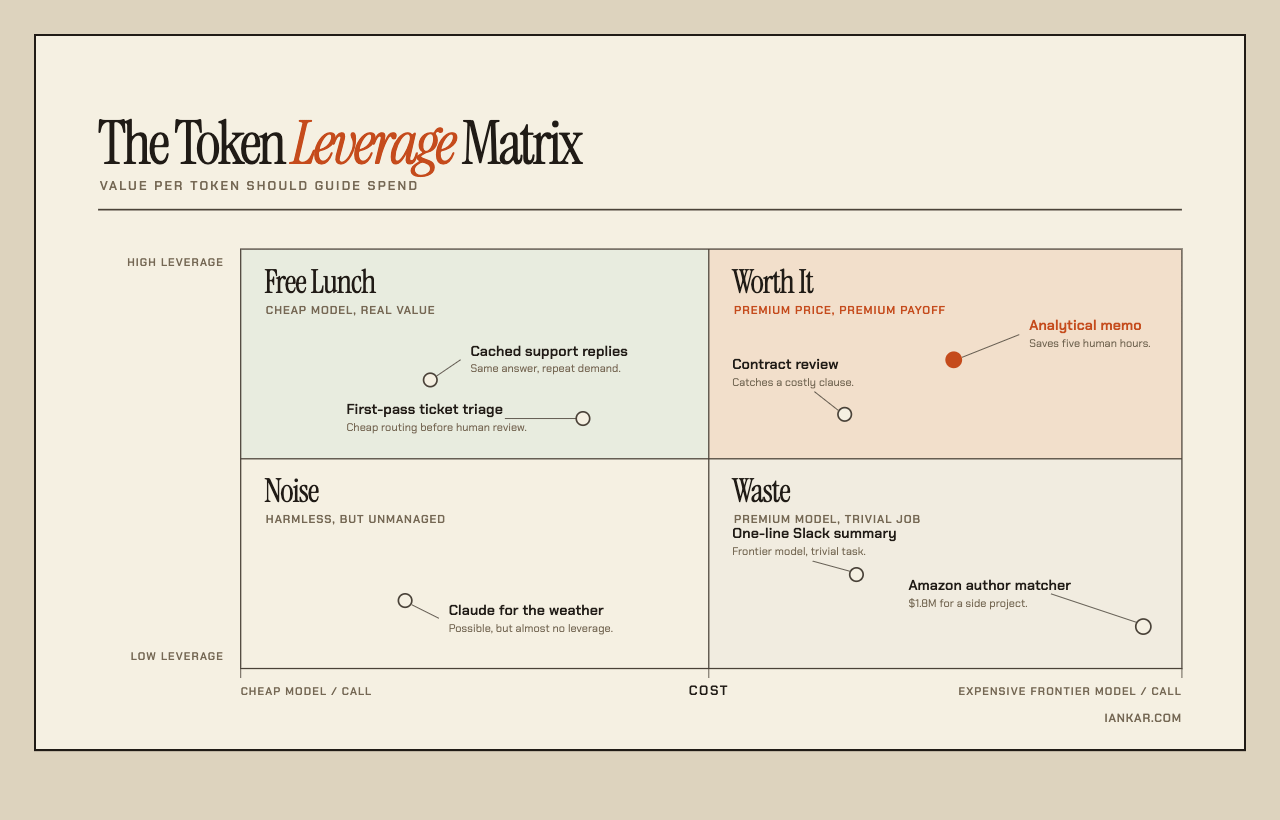
The Token Leverage Matrix — plotting AI spend by cost and leverage.
The quadrant that matters most for this piece is Waste, not because it uses the most tokens, but because it’s a frontier model doing a cheap model’s job. Cost should track leverage, not usage. A company that spends more overall but concentrates that spending in Free Lunch and Worth It is healthier than one that spends less but is stuck in Waste and Noise.
We call this VPT, or Value Per Token. For me, it’s the AI-era equivalent of unit economics. SaaS FinOps optimizes cost per seat. Cloud FinOps optimizes cost per workload. AI FinOps optimizes value created per token spent.
The smartest and most AI-pilled companies are borrowing from the early cloud era. Before cloud, IT procurement negotiated with a vendor once a year and locked in a price. AWS broke that model. Suddenly, any engineer with a credit card could spin up infrastructure, and thousands of small technical decisions started showing up on the bill.
That created cloud FinOps: a role requiring enough technical fluency to understand architecture and enough financial fluency to negotiate discounts and control costs.
AI FinOps is the same shift one layer up the stack. Instead of deciding which instance to reserve each quarter, the job is deciding which model should handle each call. That decision can happen thousands of times a day.
The job postings make the new responsibilities clear. Nearly every role we found centered on three things: managing multiple cloud and model vendors, building governance infrastructure, and working across the organization without direct authority.
Managing multiple cloud and model systems
Operationally, this was the most important requirement: hands-on experience with traditional cloud billing systems and concepts, such as reserved capacity and savings plans, alongside AI-native cost levers like token consumption, GPU utilization, inference caching, and model routing. None of these enterprises is betting on a single model provider. The postings consistently mentioned multiple vendors, including OpenAI, Anthropic, Amazon Bedrock, and Google Vertex AI, which matches what we’re seeing at Arcana Research.
That makes AI FinOps a different skill set from legacy cloud FinOps. Knowing why reserved pricing beats on-demand pricing is no longer enough. Candidates also need to understand why model costs differ, when to route a task to a cheaper model, and how to implement those controls. For executives hiring for this role, I would test for fluency in inference economics, caching, and routing, not just cloud FinOps.
Cross-functional without direct authority
Most of these positions are individual-contributor roles, which makes sense: companies are hiring someone to build the function before they build the team. The person has to work across engineering, product, finance, and procurement. ServiceNow described the role as “the connective tissue between technical usage and financial discipline.” They are expected to set budgets and guardrails, often without having any direct reports.
Building governance infrastructure, not just reporting
AI FinOps goes beyond visibility. The job is to build the plumbing that attributes AI spending to a specific team or feature so the company can connect cost back to Value Per Token and ROI. The postings repeatedly mentioned budgets, quotas, alerts, cost allocation and tagging, chargeback and showback models, and unit economics such as cost-to-serve.
The strongest candidates will have shipped a chargeback or tagging system before. Building controls before the bill arrives is a different skill from explaining the invoice afterward.
If you want one of these jobs, don’t wait for the title. Build a cost-allocation model and start figuring out which workloads belong on cheaper models. When the budget crisis arrives, the person who can explain the bill will already be doing AI FinOps.
We’ve all read the AI pundits arguing that superintelligent agents are going to take away human jobs. Nobody’s writing headlines about the ones they’re creating. AI FinOps is one of those jobs. The work depends on knowing how a company actually uses AI, which makes it difficult to hand off to an outside consultant.
That Fortune 500 exec I talked to wasn’t ahead because he had a better model or a bigger budget. His company had already figured out who was responsible for all of it. When he told me they had a few AI FinOps people, he made it sound like every company did. Most don’t, but it’s clear that’s changing.
Know someone who’d like this? Send it their way. If someone sent it to you, subscribe here.