Funnily enough, I first came across Neel Somani’s free book on TikTok. Neel used to work at Citadel, where he focused on energy, and now spends his time using AI to attack highly complex, unsolved math problems.
He recently published Power 2026: Electricity Pricing in the Age of AI, a long piece about what I think will be AI’s most critical bottleneck over the next few decades: electrical power.
The other piece comes from Ribbit Capital, a firm best known for fintech. Ribbit has started making bets around power and the physical infrastructure underneath AI, and recently published a 42-page letter laying out its thinking.
I’ve only skimmed both, so this isn’t a summary. They’re long and fairly dense. I’m sharing them now because power is important enough that more people around AI should understand it, and both pieces are accessible to non-specialists despite their length.
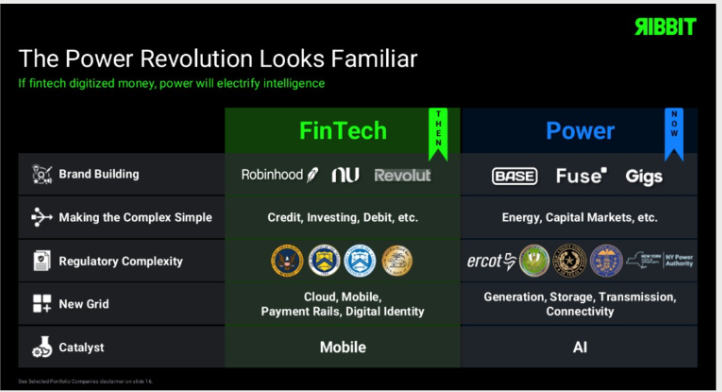
Ribbit sees several similarities between finance and power. Both are heavily regulated and deeply fragmented, which makes the underlying systems difficult for customers to understand. I’d argue that power is even more complicated because it is physical. Software can be rewritten and redeployed overnight. Power projects require land, steel, copper, transformers, interconnection agreements, regulatory approval, and years of construction.
One of the things I admire about Ribbit, and Neel too, is that neither seems beholden to one narrow area of innovation. Ribbit started with finance, which made sense given its domain experience and the secular changes reshaping the industry. Now it is following another important bottleneck.
Most venture attention still seems concentrated in the AI software layer. Far fewer firms are investing across the physical power stack, while the model layer itself is too expensive for most funds to touch.
That split matters because AGI runs counter to a lot of current investment theses. If models reach something close to AGI within five or ten years, how durable are the software businesses being built on top of them now?
Historical precedent says there will be a valuable application layer. But we’ve also never had a technology whose underlying intelligence can improve this quickly, potentially surpassing our own both individually and collectively.
The labs also need more revenue to justify their enormous capital spending. There’s a scenario where they eventually absorb some of the highest-margin B2B use cases themselves, leaving application companies to compete for thinner and less durable layers of value. That would put a lot of venture-backed startups, and the funds behind them, in an uncomfortable position.
Physical infrastructure looks different. Better models may make a particular software product obsolete, but they don’t eliminate the need for electricity. They increase it.
Power is already one of AI’s biggest constraints. Compute matters, obviously, but chip supply can expand and hardware can be optimized on cycles that are relatively short compared with utility infrastructure. Power plants, transmission lines, substations, grid connections, cooling systems, and data centers operate on physical timelines that software can’t compress.
The chips still need somewhere to sit and enough electricity to turn on.
I’m going to read both pieces properly this week. The models may keep getting smarter; the grid still has to turn them on.